Protein Percent Daily Value with PDCAAS
applies to: nutraCoster 3.0 Desktop, nutraCoster 3.0 Cloud
Introduction
Protein Percent Daily Value is optional on US Nutrition Facts labels, with the following exceptions.
- A regulated protein content claim is made, such as "High in Protein", etc.
- An implied protein content claim is made, including any mention of protein on the package.
- The product is specifically for infants or children through 3 years of age.
Canada and Mexico Nutrition regulations have no Daily Value for protein, so Protein Percent Daily Value is never included on labels.
Protein Digestibility Corrected Amino Acid Score
US nutrition labeling regulations require that Protein Percent Daily Value is calculated using a technique called Protein Digestibility Corrected Amino Acid Score (PDCAAS).
PDCAAS evaluates protein sources based on digestibility or bio-availability of the protein.
nutraCoster can do this calculation, but the requirements are strict:
- Every ingredient that has protein must have amino acid details for the protein.
- Every ingredient that has protein must have a value for Protein Digestibility.
PDCAAS uses the ratios of essential amino acids to determine the ability of the food to create the proteins required for growth.
PDCAAS also takes into account digestibility or bio-availability of different foods.
PDCAAS was developed and published by the World Health Organization (WHO) in 1989 and 1991. Here is a link to the original WHO report:
Protein quality evaluation - Report of Joint FAO/WHO Expert ConsultationAmino Acids
Essential Amino Acids
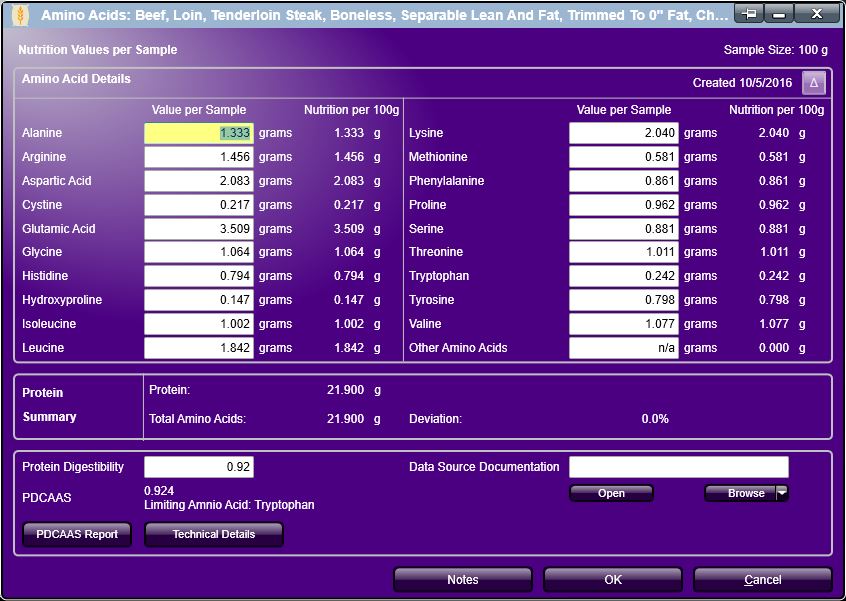
Amino acids are the building blocks for proteins. Essential amino acids are amino acids that your body cannot make on its own. You must get them from foods you eat.
There are 9 essential amino acids:
Histidine, isoleucine, leucine, lysine, methionine, phenylalanine, threonine, tryptophan and valine.
The essential amino acids must be present in specific proportions for protein synthesis to proceed. If there is insufficient amount of any one amino acid, it limits the amount of protein that can be created. That amino acid is referred to as the Limiting Amino Acid.
nutraCoster cannot calculate PDCAAS if the amino acid values are missing. Here are some solutions.
Protein Consistency
Ideally, the sum of the amino acids should equal the reported protein. Due to the statistical nature of nutrition analysis, these values will rarely match exactly.
nutraCoster allows no more than 10% variation between Total Amino Acids and Protein. Deviation of more than 10% will prevent the PDCAAS calculation. Here are some solutions.
Protein Digestibility
Not all of the protein we eat is digested. The proportion of the protein ingested that is actually used is called Protein Disgestibility.
Protein Digestibility is a number between 0 (not digested at all) and 1 (fully digested).
Protein Digestibility is difficult to measure in humans, so animal studies are used to estimate digestibility.
One technique is a rat fecal absorption study:
- Rats are fed a diet with no protein, and the amount of protein in the feces is measured.
- The rats are then fed a diet with a known amount of protein, and the amount of protein in the feces is measured.
- The difference is used to determine the amount of protein that was actually digested.
Sources for Protein Digestibility Values
Protein Digestibility values are notoriously hard to find. Here are two sources.
- Refer to Tables 8 and 9 in the WHO report referenced above.
- Here is a link to a chart of digestibility values: Digestibility Values
PDCAAS Difficulties (and how to resolve them)
Missing Amino Acids
nutraCoster is supplied with the USDA National Nutrient Database for Standard Reference (SR). It includes amino acid values for most ingredients that contain protein.
However, vendor-supplied nutrition data rarely includes values for amino acids.
- If the ingredient is a significant source of protein, you cannot do the PDCAAS calculation without the amino acid values. Speak to your vendor about obtaining the information. If the vendor cannot or will not supply the data:
- Search the Internet for alternate sources of data.
- Find a different vendor.
- Pay for a lab analysis yourself.
- If the ingredient has a non-zero but insignificant amount of protein, nutraCoster has a field in the Amino Acids window called Other Amino Acids.
- Enter a value for Other Amino Acids to make the Total Amino Acids value equal the Protein value.
Note: This technique only works if the amount of protein in the ingredient is very small. It may cause your Protein Percent Daily Value to be slightly understated. This may be acceptable if your application requires Protein Percent Daily Value on your Nutrition Facts label.
Protein Inconsistency
The nine essential amino acids are required for the PDCAAS calculation. In some cases the Total Amino Acids value will not agree with the Protein value. If the deviation is more than 10%, nutraCoster will not do the calculation.
- If the Total Amino Acids value is less than the Protein value, use the Other Amino Acids field to make up the difference.
- If the essential amino acids are present, this will not affect the PDCAAS calculation.
- If any of the essential amino acid values are 0 or n/a, that will be the Limiting Amino Acid and the PDCAAS result will be 0.
- If the Total Amino Acids value is more than the Protein value, contact the source of the nutrition data to double check the amino acids and protein values.
Missing Digestibility Values
Each ingredient that has protein must have a Digestibility value to complete the PDCAAS calculation.
Digestibility values can be hard to find. Consult the sources above for common values.
If you cannot find a digestibility value for an ingredient:
- Search the Internet for the data.
- If the ingredient has a non-zero but insignificant amount of protein, enter a low, but non-zero, value for digesibility.
- This will cause the PDCAAS result to be very close to 0.
Note: This technique only works if the amount of protein in the ingredient is very small. It may cause your Protein Percent Daily Value to be slightly understated. This may be acceptable if your application requires Protein Percent Daily Value on your Nutrition Facts label.
Protein Percent Daily Value on Nutrition Labels
Protein Percent Daily Value is optional on US Nutrition Facts labels.
To include Protein Percent Daily Value on your label:
- Choose Reports, Nutrition Labels, Recipe/Formula Nutrition Labels (or any of the other Nutrition Facts formats) from the menu.
- In the Options for Nutrition Labels window click the Optional Nutrients tab.
- In the Optional Nutrients tab click the Optional Proximates tab.
- In the Optional Proximates tab check Protein % Daily Value.
PDCAAS Report
The PDCAAS report for a recipe shows you exactly how nutraCoster calculates the PDCAAS value.
nutraCoster uses the calculation described in Chapter 8 of the WHO report.
The report uses a format similar to Table 10 in the WHO report.
Here is a sample report created with the exact ingredients and formula as Table 10 in the WHO report.
Note: nutraCoster does not round intermediate values, so the results are slightly different (and slightly more accurate) than shown in the WHO report.